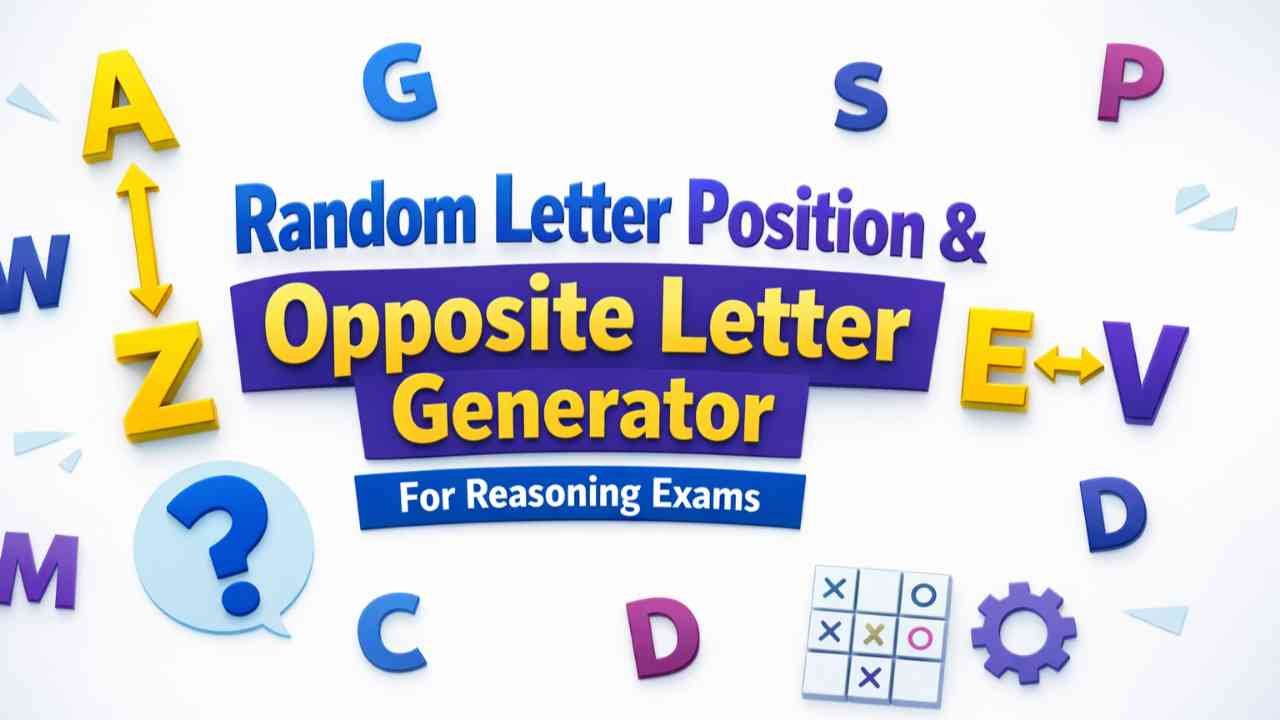
Random Letter Position and Opposite Letter Generator for Reasoning Exam
Reasoning exams like SSC, UPSSSC, High Court, Junior Assistant, RRB and many other competitive tests often ask questions based on English alphabet positions and opposite letters. Many aspirants get confused when they have to quickly find which letter comes at a particular position, or what is the opposite letter of any given alphabet. To make this practice easier and faster, this online tool “Random Letter Position and Opposite Letter Generator for Reasoning Exam” has been created.
With this tool, you can practice repeatedly and improve your speed in identifying the position of each letter and its opposite letter. Below is a complete table of all letters with their positions and opposite letters, so you can memorize and revise them quickly. We’ve also used simple colors in the table to make it visually easier to remember.
| Letter | Position | Opposite Letter |
| A | 1 | Z |
| B | 2 | Y |
| C | 3 | X |
| D | 4 | W |
| E | 5 | V |
| F | 6 | U |
| G | 7 | T |
| H | 8 | S |
| I | 9 | R |
| J | 10 | Q |
| K | 11 | P |
| L | 12 | O |
| M | 13 | N |
| N | 14 | M |
| O | 15 | L |
| P | 16 | K |
| Q | 17 | J |
| R | 18 | I |
| S | 19 | H |
| T | 20 | G |
| U | 21 | F |
| V | 22 | E |
| W | 23 | D |
| X | 24 | C |
| Y | 25 | B |
| Z | 26 | A |
What Is Letter Position and Opposite Letter Concept?
In most reasoning exams, the English alphabet from A to Z is treated as a sequence of 26 letters. Each letter has a fixed position: A is at position 1, B at 2, C at 3 and so on up to Z at position 26. Along with this, there is another very common concept called the “opposite letter” or “mirror letter”. Here, A and Z are opposites, B and Y are opposites, C and X are opposites and this pattern continues like that.
In simple words, the first letter (A) and the last letter (Z) are a pair, the second letter (B) and the second last letter (Y) are a pair, and so on. This pattern is heavily used in reasoning puzzles, coding-decoding, series questions, and alphabetical analogy questions.
Why This Tool Is Important for Reasoning Exam Aspirants
In exams such as SSC, UPSSSC, High Court, Junior Assistant, Railway (RRB) and many other state or central level competitive exams, questions based on alphabet positions are very frequent. Many students lose marks simply because they take too much time to count positions manually or they are not confident about opposite letters. If you already know the positions and opposite letters mentally, you can save precious seconds in every question.
This online “Random Letter Position and Opposite Letter Generator” helps you by giving random letters or positions so that you can practice quickly. With daily practice, your brain will start recognising the positions automatically, and you will not need to count A, B, C… every time. This increases both speed and accuracy, which are crucial for clearing reasoning sections with a good score.
How to Use the Random Letter Position and Opposite Letter Generator
The main aim of this tool is to simulate exam-like practice. You can use it in the following ways:
1. Generate a random letter and try to answer:
– What is its position in the alphabet? – What is its opposite letter? – What is the position of that opposite letter?
2. Alternatively, generate a random position (1 to 26) and then answer:
– Which letter comes at this position? – What is the opposite letter of that letter? – What is the opposite position number?
After answering, you can check your response using the tool or by referring to the table given above. With repeated attempts, you will notice improvement in your recall speed.
Smart Tricks to Remember Positions and Opposites
One simple trick to remember the opposite letter is: Position of a letter + Position of its opposite letter = 27.
For example:
– A is 1, Z is 26 → 1 + 26 = 27 – B is 2, Y is 25 → 2 + 25 = 27 – G is 7, T is 20 → 7 + 20 = 27
So, if you know the position of one letter, you can easily find its opposite by subtracting from 27. This trick is very useful in time-bound reasoning exams. While using your tool, students can keep this formula in mind and practise until it becomes natural.
Best Practice Strategy with This Online Tool
To get maximum benefit, aspirants should use this tool daily for at least 10–15 minutes. Start slowly, first focusing on learning the basic order and opposite pairs with the help of the table. Once you are comfortable with all pairs, switch to timed practice using the generator. Try to answer without looking at the table, and only check later to confirm.
You can also mix this practice with other reasoning topics like coding-decoding, alphabetical series and word formation, since all of them depend on strong knowledge of letter positions. Over time, this habit will help you handle real exam questions with confidence and minimum errors.
Enjoy our tool
The “Random Letter Position and Opposite Letter Generator for Reasoning Exam” is a very effective and simple tool for all competitive exam aspirants. It converts a theoretical concept into an interactive practice session. By repeatedly using this tool and revising the given table, you can master alphabet positions and opposite letters, improve your speed and accuracy, and ultimately score better in reasoning sections of SSC, UPSSSC, High Court, Junior Assistant, RRB and similar examinations.